What a business phone system costs in India
A business phone system in India costs more than its headline per-user price and less than most first quotes suggest. The bill has three parts: the platform, charged per extension or per user; the calling, charged per minute or bundled into an allowance; and the numbers, charged per DID per month whether used or not. Setup, porting and minimum commitments sit on top. Which part dominates depends entirely on how much your team actually talks.
Karan Sharma · Updated 2026-10-29
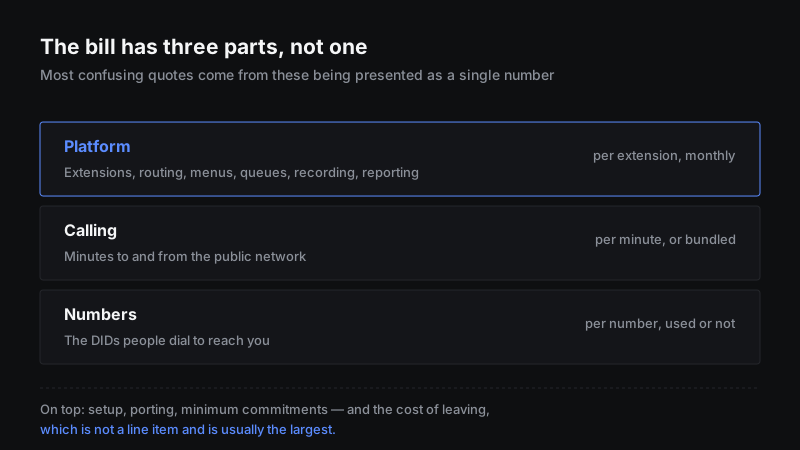
The bill has three parts, not one
Almost every confusing quote comes from these being presented as a single number. Separate them and comparison becomes possible.
| Part | What it buys | How it is usually charged |
|---|---|---|
| Platform | Extensions, routing, menus, queues, recording, reporting | Per extension or per user, monthly |
| Calling | Minutes to and from the public network | Per minute, or an allowance bundled into the platform price |
| Numbers | The DIDs people dial to reach you | Per number, monthly, used or not |
A vendor who quotes one number has made assumptions about all three on your behalf. Ask for the split before comparing anything — the exercise alone usually moves the price.
Eight things that decide what you pay
- How many people need to be reachable individually. This is the extension count, and it is usually just headcount in roles that answer calls.
- How many conversations happen at the same moment. This is channels, and it is far smaller than headcount — for most offices a quarter to a third of extensions.
- How much your team actually talks. Minutes per person per month is the number that decides whether a bundled plan helps or hurts you.
- Whether calls are mostly inbound or outbound. Many plans price them differently, and a mostly-inbound team can be paying for an outbound allowance it never uses.
- How many numbers you need, and in how many cities. Numbers rent monthly and accumulate quietly.
- Whether you keep your own carrier. If your existing rates are good, paying for the platform alone is often cheaper than any bundle.
- Whether anything is AI-driven. Agent time is metered separately and behaves like consumption, not like a seat.
- What you are locked into. Minimum seats, minimum spend and contract length convert a flexible price into a fixed one.
The costs people forget
Not hidden exactly — just not on the comparison page.
| Cost | Why it surprises people |
|---|---|
| Number rental | Charged per DID per month regardless of use. Easy to accumulate across cities and campaigns. |
| Porting | Moving existing numbers involves your old carrier, who has no incentive to hurry. Sometimes free, sometimes not. |
| Setup and onboarding | Often waived, sometimes not, and rarely in the headline price. |
| Overage rates | The rate once a bundled allowance runs out, which is almost never the competitive one. |
| Recording storage | Retention beyond the included period, which you discover during an incident rather than before one. |
| Leaving | If the numbers belong to the vendor, changing provider is a migration rather than a configuration change. |
That last row is not a line item and is usually the largest. It is also the one you decide at purchase, not at exit.
Building a number you can defend
Four steps, using data you already have. Do this before anyone quotes you, because a quote is built around whatever you tell them.
- Count extensions: people who need to be reachable individually, plus shared endpoints like reception or a meeting room.
- Pull three months of talk minutes from your current bill or call records. Divide by three, then by the number of people who actually call. That is minutes per person per month.
- Find your peak concurrent calls from the same records. That sets channel capacity, and it is the number you will be asked for.
- Count the numbers you genuinely need, separating ones customers dial from ones that exist for a campaign that ended.
With those four figures you can price any proposal yourself, in a spreadsheet, without the vendor's calculator. If a quote cannot be rebuilt from them, something is being assumed that you have not agreed to.
Where the money usually goes wrong
- Buying channels like extensions. Thirty staff rarely means thirty simultaneous calls, and paying as though it does is the most common overspend.
- Accepting a bundle without checking usage. Light callers subsidise heavy ones; heavy callers meet the overage rate.
- Letting numbers accumulate. Nobody cancels a DID from a campaign that ended two years ago.
- Throwing away a good carrier contract to simplify an invoice. Tidiness is rarely worth the rate difference.
- Under-provisioning channels to save a little. The call that gets a busy signal is the one you could least afford to lose.
What is not a cost question
Two things get argued about on price and should not be.
The first is reliability. A system that drops calls is not cheaper, whatever the invoice says, and the difference between providers on this is far larger than the difference on price. Ask what happens to a call in progress during an outage, and where your numbers fail over to.
The second is whether you can leave. A platform you can migrate away from without renegotiating your telecom contract is worth paying something for, and the premium is usually smaller than one month of a bad migration.