The hidden cost of bundled minutes
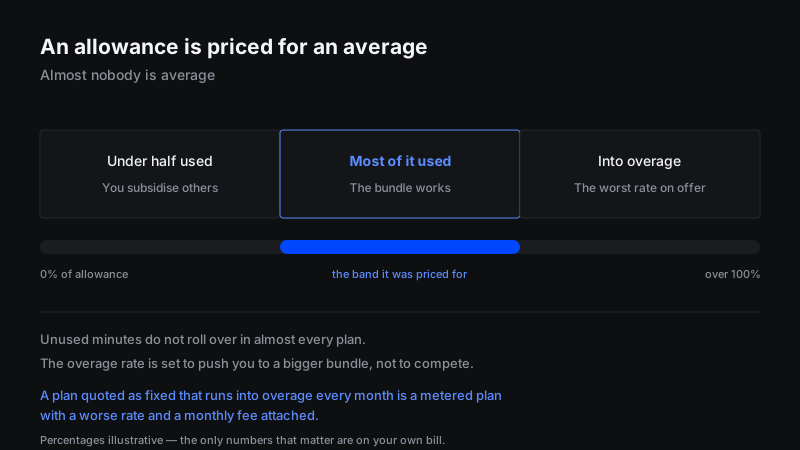
A bundled plan charges a fixed monthly price with a call allowance included. It is good value if your usage sits near the allowance, and poor value at either extreme: talk much less and you are paying for minutes that expire every month, talk much more and you meet an overage rate that is rarely competitive. The allowance is priced for an average, and almost nobody is average.
Karan Sharma · Updated 2026-10-29
What a bundle actually prices
An allowance is an average with a margin on top. The provider knows roughly what a customer of your size consumes, prices a little above it, and relies on light users offsetting heavy ones.
That is not a scam — it is insurance, and it is the same arithmetic behind any fixed-price plan. It gives you a predictable bill, which has real value. The question is only whether you are the customer the average was built around.
Two things follow, and both are easy to check.
- Unused minutes do not roll over, in almost every plan. An allowance you consume half of is a bill you are paying twice the effective rate on.
- The overage rate is set to discourage, not to compete. It is usually well above what you would pay on a metered plan, because its job is to push you to a bigger bundle.
Two numbers tell you which side you are on
Your actual minutes, and the allowance. Divide one by the other.
| If you use… | of your allowance | then… |
|---|---|---|
| Under half | < 50% | You are subsidising heavier callers. A metered plan is almost certainly cheaper. |
| Most of it | 60–90% | The bundle is doing its job. This is who the price was built for. |
| All of it, often | > 100% | You are paying the overage rate, which is the worst rate on offer. Move tier or move model. |
The uncomfortable case is the third one, because it is invisible until you read an itemised invoice. A plan quoted as fixed that regularly runs into overage is a metered plan with a worse rate and a monthly fee attached.
The costs that come with the convenience
- Rate opacity. A bundle hides the per-minute cost, so you cannot tell whether your calling is expensive until you leave.
- Seasonality punished twice. A quiet quarter wastes allowance; a busy one triggers overage. Businesses with lumpy demand lose at both ends.
- Growth priced in steps. Adding one more caller can push you into the next tier, so the marginal cost of a hire is a cliff rather than a slope.
- The numbers usually belong to the provider. Bundles bind the calling to the platform, so leaving means porting rather than reconfiguring.
The last one is the one that compounds. Everything else is money; that one is optionality, and you only find out what it was worth when you want to change something.
When a bundle is genuinely the right answer
Often, and anyone who tells you otherwise is selling the alternative.
- Your usage is steady and sits comfortably inside the allowance. Predictability is worth paying a little for, and you are paying very little.
- You have no carrier relationship and no appetite to acquire one. A second supplier is overhead that a small team will not recover.
- You need one party accountable when call quality degrades. Bundling is the honest way to buy that.
- Your finance team values a flat line more than the lowest possible number. That is a legitimate preference, not a mistake.
What to ask before signing
- What exactly is in the allowance — inbound, outbound, mobile, landline, which destinations? The exclusions are where the surprises live.
- What is the overage rate, in writing, and how does it compare with your current per-minute cost?
- Do unused minutes roll over, and if so for how long?
- Can I move down a tier as easily as up, and at what notice?
- If I bring my own carrier later, is there a platform-only price — or do I pay the bundled rate regardless?
- Who owns the numbers, and what does porting out involve?
Where we are the wrong answer
If your calling is steady, modest and entirely domestic, and nobody internally wants to think about telephony again, a good bundled plan from a single provider will serve you well and this page has not argued otherwise.
Unbundling pays when usage is heavy, lumpy, or when the carrier relationship is worth keeping in your own name. If none of those is true, the saving will not repay the extra supplier.